Key Takeaways:
- Promoting your top sales rep to manager is a $150,000 mistake that kills both revenue and morale
- The skills that make someone a great closer are the opposite of what makes them a great manager
- You lose your best revenue generator and gain an inexperienced manager who lacks infrastructure-building skills
- A Fractional Sales Leader builds the management infrastructure first, then helps you hire or promote the right person to run it
What Makes a Great Salesperson?
A great salesperson has intuition. They read the room. They build personal relationships. They close deals through force of personality and charisma. They are lone wolves who hunt successfully.
This is exactly why they fail as managers.
The $150,000 Mistake Founders Make
You are at $3 million in ARR. Your top rep, let's call her Sarah, is crushing quota. She closed $800,000 last year. She is confident, articulate, and your prospects love her.
And you are drowning. You need help managing the team. The logical move seems obvious: to promote Sarah to Sales Manager.
This is the single most expensive mistake founders make in the $1M-$10M ARR range.
Here is what happens next:
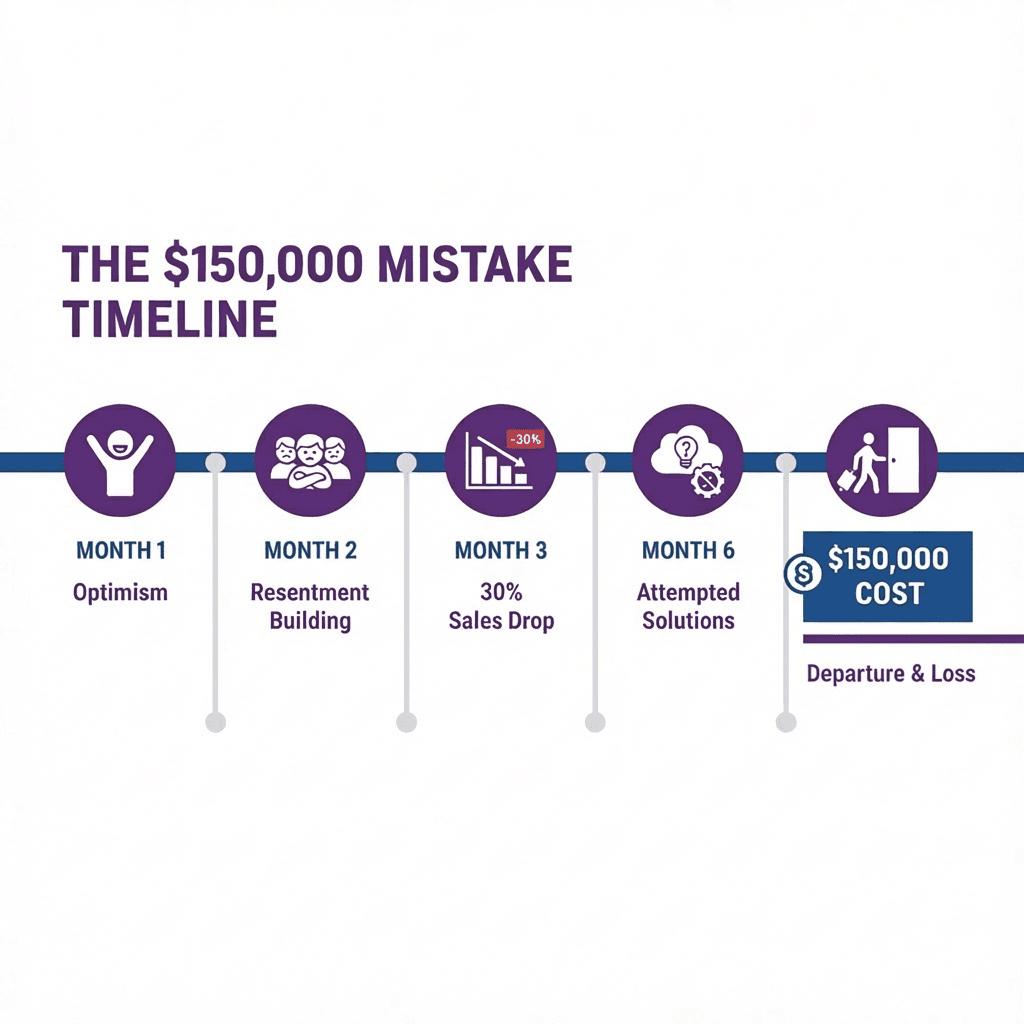 The typical 6-month pattern when promoting your top rep to manager without proper infrastructure.
Month 1: Sarah is excited. She starts attending "leadership" webinars. She talks about "empowering the team."
Month 2: Your other reps are confused. Sarah was their peer last month. Now she is critiquing their calls. Resentment builds.
Month 3: Pipeline velocity drops 30%. Sarah is spending her time in one-on-ones instead of closing deals. The team is not improving, and you have lost your best closer.
Month 6: You fire Sarah or demote her. You have lost $150,000 in opportunity cost, destroyed team morale, and you are back where you started.
This pattern repeats itself in thousands of companies every year. The problem is not Sarah. The problem is the assumption that sales ability equals management ability.
The Superstar Rep Trap: Why This Always Fails
Reason #1: You Lose Your Best Revenue Generator
Let's do the math. Sarah was closing $800,000 per year. As a manager making $120,000 base, she would need to improve team performance by at least $800,000 just to break even on the decision.
But here is the reality: new managers typically decrease team performance for the first six months as they learn the role. Meanwhile, her replacement rep takes 6-9 months to ramp to full productivity.
Net result: You have traded certain revenue for uncertain management outcomes.
Reason #2: Sales Skills ≠ Management Skills
Great salespeople operate on intuition. Ask Sarah why she closed that deal and she will say, "I just felt like they were ready to buy."
That is useless to the struggling rep who needs to learn how to close.
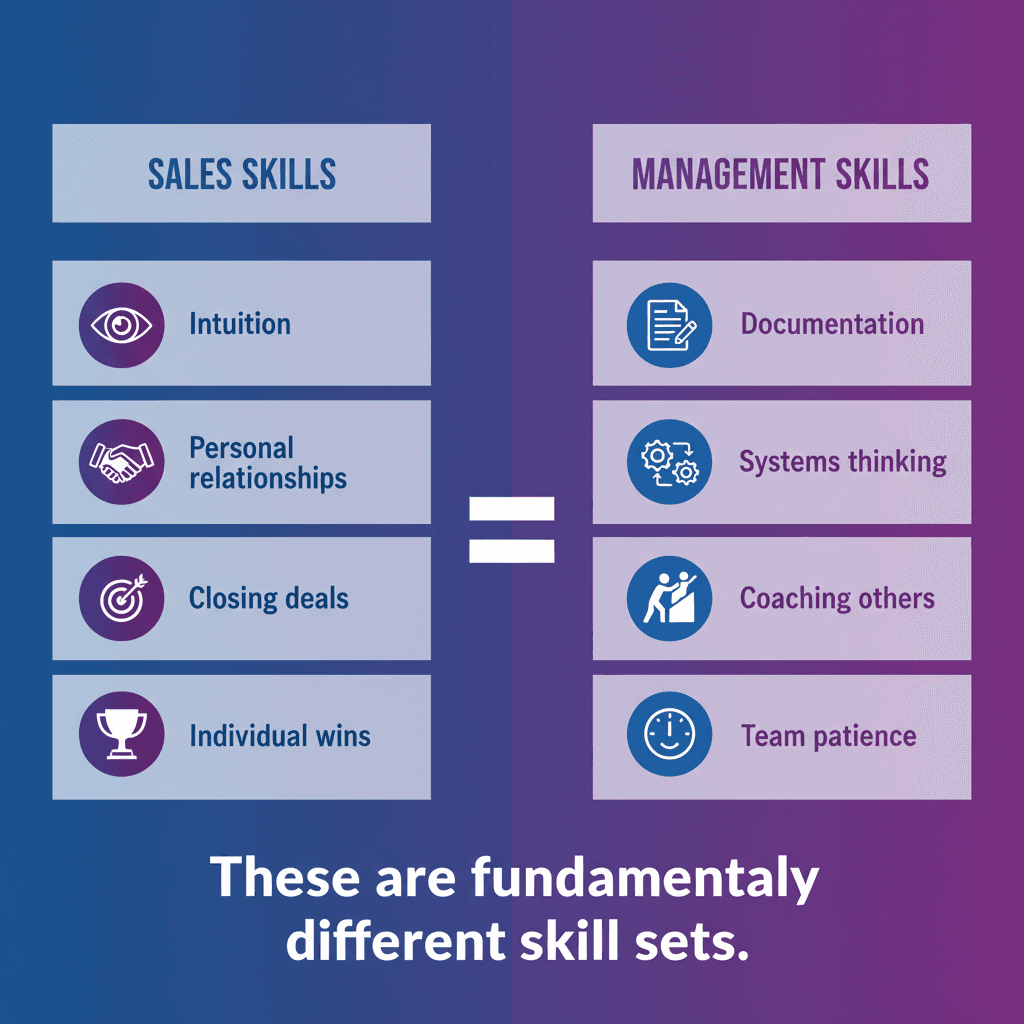 The skills that make someone a great salesperson are fundamentally different from management skills.
Management requires the opposite skillset:
- Documentation: Turning intuition into a repeatable process
- Systems Thinking: Building infrastructure that scales beyond one person
- Coaching: Teaching someone else to do what you do naturally
- Patience: Watching someone struggle through a call instead of taking over
These are not skills that Sarah developed while closing deals. She spent her career optimizing for short-term wins (commissions), not long-term team development.
Reason #3: They Manage Like They Sell (Heroically, Not Systematically)
Sarah's sales approach was heroic. She stayed up late crafting custom proposals. She took prospects to dinner. She closed deals through sheer force of will.
As a manager, she replicates this approach. Instead of building a system that teaches reps to close independently, she jumps in to "save" every struggling deal. She becomes the Super Manager, just as she was the Super Rep.
The team becomes dependent on her. When she is in a client meeting, nothing gets done. You have not solved the bottleneck problem; you have just moved it from yourself to Sarah.
The Psychology of the Promoted Rep
There is another problem that founders do not anticipate: the psychological burden of managing former peers.
The Authority Paradox
Sarah was grabbing beers with Tom and Jessica last month. Now she has to tell Tom his discovery calls are weak and put Jessica on a Performance Improvement Plan (PIP).
This creates cognitive dissonance. Sarah wants to be liked by her former peers, but effective management requires making uncomfortable decisions. Most newly promoted managers choose to be liked, which means they avoid difficult conversations.
Result: Underperformers stay too long, top performers leave because they see no accountability, and the culture deteriorates.
The Imposter Syndrome Spiral
Even if Sarah has confidence in her sales ability, she has never built a sales playbook. She has never configured CRM workflows. She has never written a compensation plan.
When the founder asks, "Why is our closing ratio declining?" Sarah does not have the analytical framework to diagnose the problem. She just knows it "feels wrong."
This imposter syndrome leads to one of two outcomes:
- Paralysis: She avoids making changes because she is afraid of making things worse
- Chaos: She makes dramatic changes (new CRM, new scripts, new everything) hoping something sticks
Neither approach works. The team loses confidence in her leadership, and the founder loses confidence in the promotion decision.
What to Do Instead: The Infrastructure-First Approach
The correct sequence is not: Great Rep → Manager → Systems.
The correct sequence is: Systems → Manager → Scale.
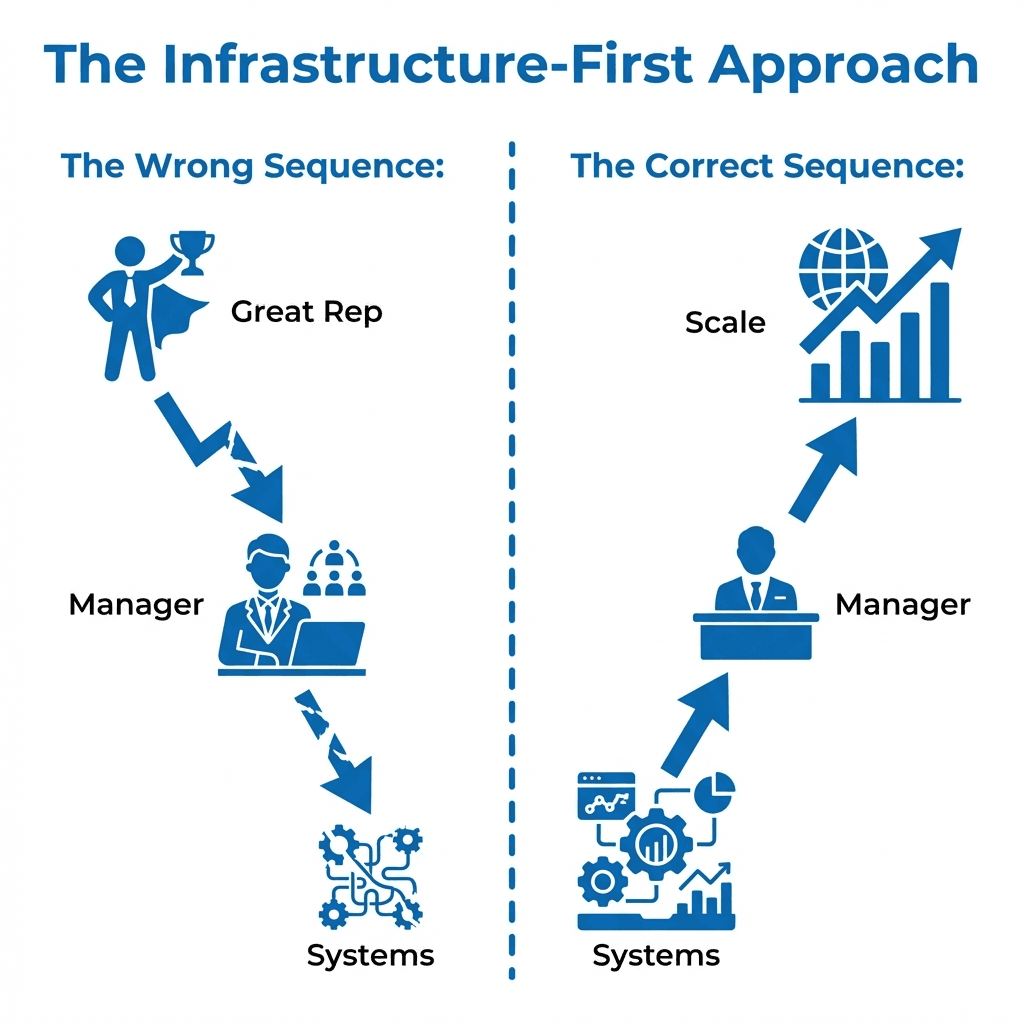 Build the management infrastructure first, then decide who should run it.
Before anyone can manage effectively, you need infrastructure. This is where a Fractional Sales Leader provides the solution.
Phase 1: Build the Foundation (Months 1-3)
A Fractional Sales Leader comes in and builds what Sarah cannot:
The Sales Playbook: We document the process. Not "Sarah's intuition," but a step-by-step guide that any trained rep can follow.
CRM Configuration: We set up the pipeline stages, entry and exit criteria, and automated reporting so that performance is visible, not guessed at.
Position Contracts: We define what success looks like for each role. Not vague goals like "be a team player," but measurable outcomes like "12 qualified opportunities per month."
Training Protocols: We create onboarding programs so that new hires ramp in six weeks, not six months.
This infrastructure is what Sarah needed but did not know how to build.
Phase 2: Identify or Hire the Right Manager (Months 4-6)
Now that systems exist, we can answer the real question: "Who should run this machine?"
Maybe it is Sarah. But now she is managing a system, not inventing one from scratch. Her job is to enforce the playbook, coach reps on execution, and identify where the system is breaking.
Or maybe it is not Sarah. Maybe the right manager is someone with infrastructure-building experience who we hire externally. The Fractional Leader conducts the interviews, screens for the skills that actually matter, and ensures you do not hire another "resume padder" who talks a good game but has never built anything.
Phase 3: The Handoff (Months 6-12)
Once the right manager is in place and trained, the Fractional Leader steps back. The manager now runs the weekly pipeline reviews. They coach the team. They own the outcomes.
The Fractional Leader remains available for strategic support, but the day-to-day execution belongs to the manager.
This approach de-risks the promotion decision. If Sarah succeeds as a manager, great. If she does not, you have not destroyed your revenue engine while figuring that out.
Real-World Example: The Right Way
One of my clients, a $4M ARR SaaS company, had this exact scenario. Their top rep, Marcus, was lobbying for a management role.
Instead of promoting him immediately, we did the following:
Step 1: I came in as the Fractional Sales Leader and built the infrastructure (playbook, CRM workflows, comp plans).
Step 2: I ran the team for 90 days while Marcus shadowed me. He attended every pipeline review, listened to my coaching sessions, and learned how to diagnose problems systematically.
Step 3: We gave Marcus a "Player-Coach" role. He kept a reduced quota ($400K instead of $800K) and managed two junior reps. This let us test his management ability without removing him from revenue generation entirely.
Outcome: After six months, it became clear that Marcus was excellent at coaching but hated the administrative work (CRM hygiene, reporting, hiring). We brought in an external Sales Manager to handle operations, and Marcus became the "Head of Sales Development" focused purely on coaching and closing strategic deals.
Result: Revenue increased 40% year-over-year. Marcus was happy. The team was happy. The founder was no longer the bottleneck.
This would never have worked if we had just promoted Marcus on day one and hoped for the best.
How to Spot the Warning Signs
If you are considering promoting your top rep to manager, ask yourself these questions:
Can they articulate their sales process in a way that someone else could replicate it? If they say "I just wing it" or "I go with my gut," they are not ready.
Have they ever trained another rep successfully? If the answer is no, they have never proven they can transfer knowledge.
Do they have patience for repetitive coaching? Management is 80% saying the same thing over and over until the team internalizes it. If they get frustrated easily, they will fail.
Do they think strategically about systems, or do they just think tactically about deals? Ask them: "If you were managing the team, what would you change?" If they cannot describe infrastructure improvements (CRM workflows, onboarding processes, comp plan fixes), they are not thinking like a manager.
Are they respected by their peers, or just liked? Popularity does not equal respect. Effective managers earn respect through competence, not charisma.
If the answer to most of these questions is "no," do not promote them yet. Build the infrastructure first.
The Fractional Sales Leader Advantage
A Fractional Sales Leader solves the promotion dilemma by removing the guesswork.
We do not just advise you to "build systems." I build them. We run the team. We hold people accountable. We prove that the process works before you commit to a permanent hire.
Here is what I provide:
Operational Expertise: I have built sales teams at multiple companies. I know what works and what breaks.
Objectivity: I am not emotionally attached to your reps. We can make tough calls without guilt.
Flexibility: We cost 1/3 of a full-time VP. If the engagement does not work, you can end it without severance packages or legal headaches.
Outcome Accountability: I am measured on results (pipeline velocity, close rates, team performance), not activity (meetings attended, reports generated).
As one client said:
"Louie came in and helped bring together all our sales efforts into a system with a Sales Playbook, realistic pipeline, and defined roles. We are better off from having Louie here." — Ted Alvarado
This is what infrastructure looks like. This is what your top rep needs before they can succeed as a manager.
Frequently Asked Questions
These are the most common questions I hear from sales leaders considering promotion decisions. Have a question not covered here? Schedule a call to discuss your specific situation.
Q: What if my top rep will quit if I don't promote them?
A: If they are a high performer, have an honest conversation. Explain that you want to set them up for success, not failure. Offer them a "Player-Coach" role where they keep a reduced quota while learning management. If they refuse and quit, they were not the right cultural fit anyway. Great reps want to win, not just collect a title.
Q: How long should I wait before promoting someone to management?
A: Wait until you have documented systems in place. If you cannot hand someone a Sales Playbook, a CRM workflow diagram, and a Position Contract on day one, you are not ready to hire or promote a manager. They will spend six months building what should already exist.
Q: Can a Fractional Sales Leader work with my existing team while building infrastructure?
A: Yes. That is exactly what we do. We embed within your organization, run the day-to-day sales operations, and build the systems in parallel. Your team keeps selling while we install the infrastructure around them. This is far more efficient than halting sales to "figure things out."
Q: What if I have already promoted my top rep and it is not working?
A: It is not too late. Bring in a Fractional Sales Leader to build the infrastructure your promoted rep lacks. We can coach them on the management skills they need. If after 90 days it is clear they are not suited for management, we help you transition them back to a sales role (or exit gracefully) while we hire the right manager. This salvages the relationship and protects revenue.
Q: How much does a Fractional Sales Leader cost compared to promoting internally?
A: A Fractional Sales Leader costs $6,000-$12,000 per month. Promoting your top rep typically costs $150,000+ in lost revenue (from their reduced selling time) plus $50,000-$100,000 in team productivity losses while they figure out management. The fractional approach costs 30-50% less and de-risks the entire transition.
Conclusion
Promoting your top sales rep to manager is not a promotion. It is a gamble.
You are betting that their sales skills will translate to management skills. You are betting that they can build infrastructure they have never built before. You are betting that their peers will respect them as a leader.
The odds are not in your favor.
Instead, invest in the infrastructure first. Bring in someone who has built sales teams before. Let them create the system. Then, and only then, decide if your top rep is the right person to run it.
Your top rep will thank you. Your team will thank you. Your P&L will definitely thank you.
Ready to Build the Right Foundation?
If you are tired of guessing whether your top rep can manage, or if you have already made the promotion mistake and need to fix it, let's talk.
I help $1M-$10M ARR companies build the sales infrastructure that makes management possible.
Schedule a 30-minute consultation call to discuss your specific situation.
About the Author
Louie Bernstein is a Fractional Sales Leader and LinkedIn Top Voice with 50 years of sales experience helping $1M-$10M ARR companies build repeatable sales systems. He founded MindIQ (INC 500 company) and has worked with dozens of founders to scale beyond founder-led sales.
Connect with Louie:
Tags: Sales Management, Sales Leadership, Fractional Sales Leader, Sales Team Building, Sales Promotion, Sales Infrastructure